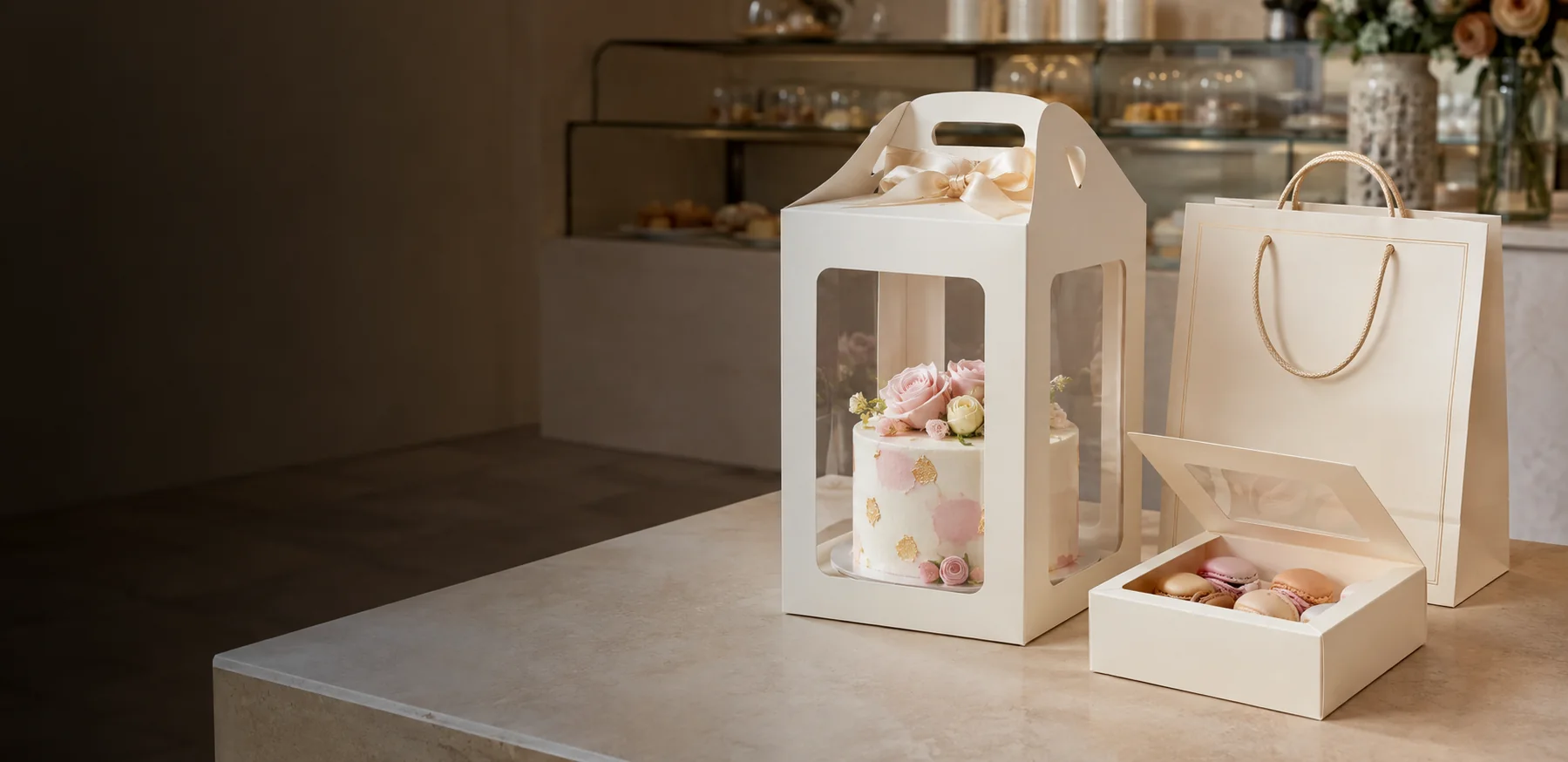
Buying answer: Specify the cake board and the fully decorated cake, not only the pan diameter. Ask the supplier to confirm usable internal length, width and height, including any insert and opening restrictions. Approve a loaded sample before ordering in bulk.
Why a matching size label may still fail
In Reddit baking discussions, buyers ask why a cake board and cake box carrying the same nominal size do not fit together. Others struggle with decorations that rise above a carrier lid. These are useful warnings about incomplete specifications, not evidence that every supplier measures boxes in the same way.
State whether a requested dimension is external or usable internal. Include board thickness, scalloped edges, side decorations and the tallest topper. A board that just fits on the base may still be difficult to insert through the opening.
Take these measurements
| Measurement | What it controls |
|---|---|
| Board width/diameter and thickness | Base fit, carrying support and insertion path |
| Maximum decorated width | Side clearance for icing, fruit, handles or ribbons |
| Total height from the bottom of the board | Lid and window clearance, including toppers |
| Filled weight | Base construction, handles and reinforcement review |
| Product count and arrangement | Insert layout, dividers and removal access |
| Packing temperature and journey | Moisture exposure, holding conditions and handling checks |
A worked sizing brief
Hypothetical example: your finished cake sits on a 250 mm board and the total decorated height is 220 mm from the bottom of that board. Do not order a box solely because its name includes “250 mm.” Tell the supplier that these are the contents dimensions and request a drawing showing usable clearance around the board and above the decoration.
If the supplier proposes a 260 mm usable internal width, the board has 5 mm clearance on each side when centered. That arithmetic does not establish a universal safe clearance: the opening, insert, dimensional tolerance and handling still need a physical check. A larger box without board restraint may simply allow more movement.
Match the opening to the product
A removable lid or side-opening structure may make placement easier for a tall or delicate cake. Review how staff will load and remove the product without touching decoration. Check the lid path as well as the final closed position; a window or flap must not press against a topper while closing.
For macarons, cookies or mini pastries, provide the largest item dimensions and layout. A divider must retain the product while leaving room for fingers or the intended removal method.
Test before you approve bulk production
- Assemble the sample and verify the base, seams and opening.
- Load the representative board and finished product.
- Close the lid slowly and inspect all decoration clearances.
- Carry the loaded pack using the intended method; inspect base and handle behavior.
- Review a representative journey and holding period under the actual product conditions.
- Record any movement, moisture, grease marks, window issues or deformation.
A paper box alone is not temperature control and does not determine shelf life. Food-contact suitability and any required documentation must be reviewed for the actual materials and intended use; a generic “food grade” label is not a complete specification.
Copy this inquiry checklist
Send board dimensions, decorated size, total weight, quantity, window/opening preference, insert layout, packing temperature, delivery country/postcode and arrival date. Attach a photo with a ruler where possible. Compare cake box formats and bakery packaging options against the same brief. Keep the approved sample and artwork revision for the next order.
Request a specification-based quote
Send dimensions, quantity, artwork and destination. Samples, production and freight are confirmed for your project.
Discuss this guide with Jennifer · Send a packaging inquiry