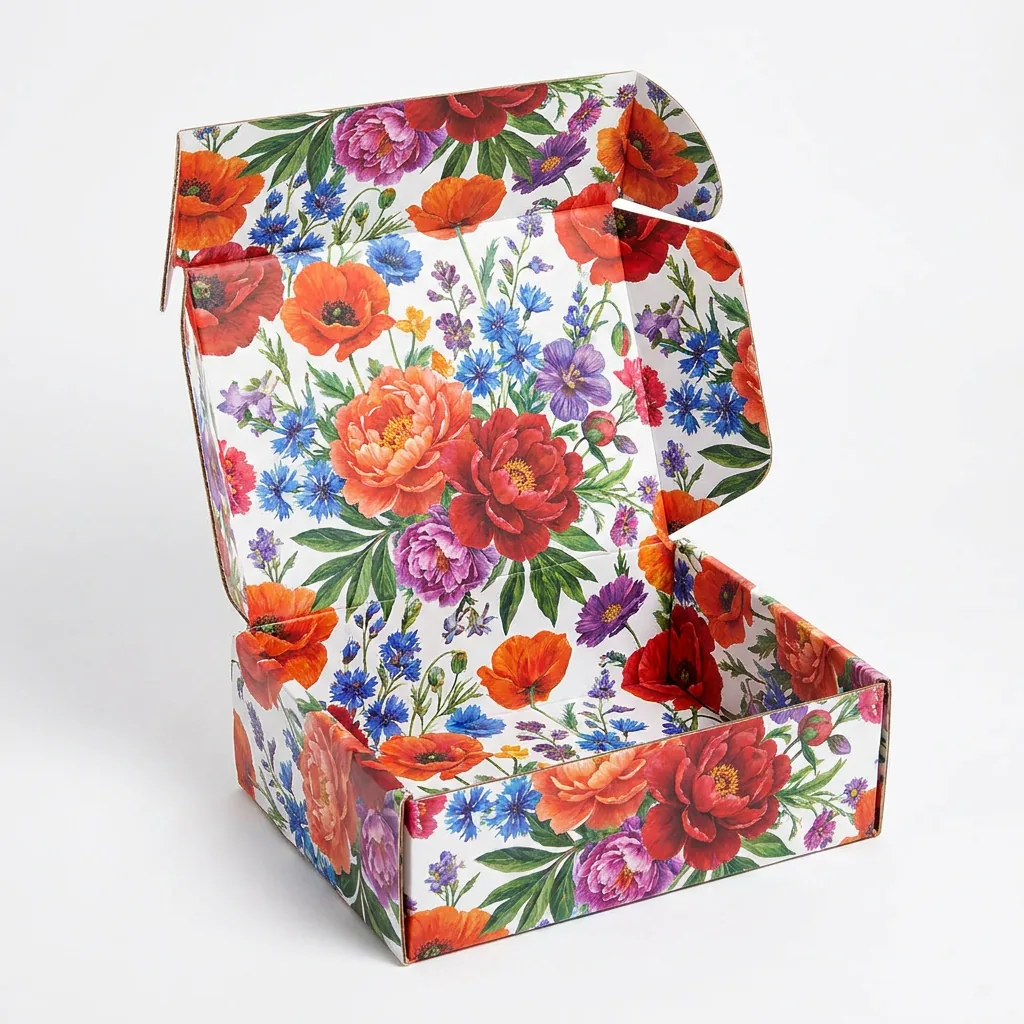
The practical difference
A standard shipping box uses an existing size and usually minimal customization. It is fast to source, flexible for changing product mixes and suitable for early testing. A custom mailer is developed around a product, packing sequence and brand presentation. It can reduce unused space and combine protection with the customer-facing experience, but it requires specification work, sampling and production planning.
| Decision factor | Standard shipping box | Custom mailer box |
|---|---|---|
| Availability | Often quicker from stock | Produced to approved specification |
| Size | Choose the nearest available size | Developed around product and insert |
| Branding | Labels, tape or simple print | Integrated inside/outside graphics and finishes |
| Protection | May need extra void fill | Fit and insert can be engineered together |
| Order commitment | Useful for uncertain or small demand | Best when demand and specification are stable |
| Planning | Shorter setup path | Dieline, proof, sample and production approval |
When a standard box is the better decision
- You are validating a new product and order volume is uncertain.
- Your assortment changes frequently and one package must serve many items.
- Speed is more important than optimizing package dimensions.
- A branded label, sleeve or tape gives enough differentiation.
- You cannot yet provide stable product dimensions or final artwork.
Using a standard box first is not a failure of branding. It can be a sensible validation stage while you collect damage, packing-time and customer-feedback data.
When custom mailers create measurable value
- A stable product sells in repeatable quantities.
- Excess void fill or oversized cartons create cost or waste.
- Damage or presentation problems can be addressed through better fit.
- Unboxing is an important customer touchpoint.
- Packing teams need a repeatable structure and clear assembly.
- Multiple components can be organized in one fitted presentation.
Compare total landed and operating cost
Unit box price is only one line in the decision. Include void fill, tape, labels, packing labor, storage volume, export cartons, freight, damage, replacement and the value of the customer presentation. A custom box may cost more per piece but reduce other costs; it can also cost more overall if the order is too fragmented or the design is over-specified.
Run the comparison using the same forecast period and realistic order quantities. Ask the custom supplier for flat-pack dimensions and export-carton data so freight estimates are based on the planned packing method.
A lower-risk transition plan
- Measure the current pack. Record box, void fill, packing time, storage and damage observations.
- Choose one stable SKU. Avoid beginning with the entire product range.
- Set success criteria. Define fit, appearance, assembly and delivery requirements.
- Approve a physical sample. Test with the actual product and fulfillment process.
- Run a controlled first order. Keep revision records and collect feedback before expanding.
Information needed for a useful comparison
Compare a custom mailer with your current box
Send your present box size, product dimensions, quantity and destination. We offer a free-sample route and reply within two hours with the questions needed for a fair comparison.